Guide: Build a hybrid app (REST + MCP)
The payoff of "servers are components over one container": run a REST API and an MCP server in the same process, often backed by the same Zod schemas and the same services. One business rule, two surfaces — an HTTP endpoint for apps and an MCP tool for agents — with no duplicated logic.
Working examples:
examples/hello-hybrid(pnpm -F hello-hybrid start) andexamples/hello-client.
One process, two servers
import {RestApplication} from '@agentback/rest';
import {MCPComponent} from '@agentback/mcp';

const app = new RestApplication(); // binds servers.RestServer
app.component(MCPComponent); // binds servers.MCPServer

app.restController(GreetingController); // REST surface
app.service(EchoTools); // MCP surface (an MCP_SERVERS extension)

app.configure('servers.RestServer').to({port: 3000});
app.configure('servers.MCPServer').to({name: 'hello-hybrid', version: '1.0.0'});

await app.start(); // BOTH servers start; each discovers its own bindings by tag
app.start() walks the lifecycle and starts every servers.* binding. The REST
server finds controller-tagged bindings; the MCP server finds
mcpServer-tagged ones. They share the container, so they also share any service
you bind.
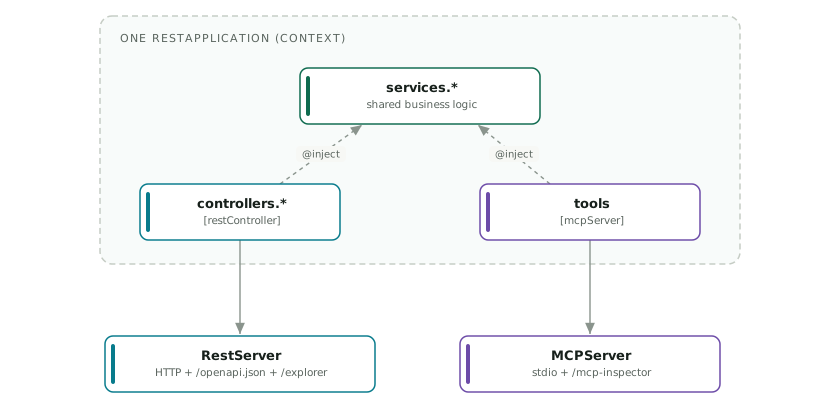
diagram source (mermaid)
graph TD
  subgraph App["one RestApplication (Context)"]
    Svc["services.* (shared business logic)"]
    Ctl["controllers.* [controller]"]
    Tool["tools [mcpServer]"]
  end
  Ctl --> RS["RestServer → HTTP + /openapi.json + /explorer"]
  Tool --> MS["MCPServer → stdio + /mcp-inspector"]
  Ctl -.@inject.-> Svc
  Tool -.@inject.-> Svc
Share logic, not just process
Put the real work in a service and inject it into both a controller and a tool. The HTTP route and the MCP tool become thin adapters over one implementation:
@injectable({scope: BindingScope.SINGLETON})
class Forecaster {
  forecast(city: string) {
    return {city, forecast: 'sunny'};
  }
}

@api({basePath: '/weather'})
class WeatherController {
  constructor(@inject('services.Forecaster') private fc: Forecaster) {}
  @get('/{city}', {path: CityPath, response: Forecast})
  async get(input: {path: {city: string}}) {
    return this.fc.forecast(input.path.city);
  }
}

@mcpServer()
class WeatherTools {
  constructor(@inject('services.Forecaster') private fc: Forecaster) {}
  @tool('forecast', {input: CityIn, output: Forecast})
  forecast(input: {city: string}) {
    return this.fc.forecast(input.city);
  }
}
Both can even reuse the same response schema (Forecast) — REST validates it
as an HTTP response, MCP validates it as tool output. One artifact, two
boundaries; see Schema-first decorators.
Mount both UIs
import {installExplorer} from '@agentback/rest-explorer';
import {installInspector} from '@agentback/mcp-inspector';

await installExplorer(app, {title: 'Hybrid REST'}); // /explorer
await installInspector(app, {title: 'Hybrid MCP'}); // /mcp-inspector
await app.start();
Now /explorer browses the REST API and /mcp-inspector exercises the tools —
both served by the same process.
A type-safe client with no codegen
Because the contract is the Zod schema, a TypeScript consumer can import the
exact same schemas and get a fully typed client with no generated SDK and no
spec round-trip — @agentback/client.
Share the schemas
Keep schemas in a module the server and client both import. In a monorepo,
export them from the server package (e.g. hello-rest/schemas) — but never
from the server's main entry, or importing the schemas would also boot the
server.
// schemas.ts — imported by server controllers AND client route handles
export const HelloPath = z.object({name: z.string().min(1)});
export const Greeting = z.object({greeting: z.string()});
Define route handles
import {createClient, routeGroup} from '@agentback/client';
import {Greeting, HelloPath, EchoIn, EchoOut} from 'hello-rest/schemas';

const greet = routeGroup('/greet');
const hello = greet.get('/hello/{name}', {path: HelloPath, response: Greeting});
const echo = greet.post('/echo', {body: EchoIn, response: EchoOut});

const client = createClient({baseURL: 'http://localhost:3000'});

const out = await hello.call(client, {path: {name: 'Alice'}});
//    ^^^ inferred {greeting: string}, validated against Greeting at runtime
route.call(client, input)— throws on non-2xx; returns the validated body.route.safeCall(client, input)— returns a discriminated{success, ...}result (mirrors Zod'ssafeParse) for when a non-2xx is an expected path.route.url(client, input)— composes the URL without firing a request.
Authenticated calls
The headers option is a (possibly async) function, so token refresh is natural:
const {token} = await login.call(anon, {
  body: {username: 'alice', roles: ['admin']},
});
const authed = createClient({
  baseURL,
  headers: () => ({authorization: `Bearer ${token}`}),
});
await me.call(authed); // sends the bearer token
Drift is caught at the call site: change a shared schema and TypeScript flags
every client call that no longer matches — no regeneration step. (Non-TypeScript
consumers still get /openapi.json for standard codegen.)
When to go hybrid
Reach for one process serving both when:
- The same domain logic should be reachable by both apps (HTTP) and agents (MCP).
- You want a single deploy unit, config, and auth story.
Keep them separate when the surfaces have independent scaling, security boundaries, or release cadences — the framework supports both; it's a binding/ component decision, not a rewrite.
Next
- Composition & extensibility — bundle these surfaces into reusable components and add cross-cutting behavior.
- Architecture overview — how dispatch and discovery actually work under the hood.