Concept: Schema-first decorators
This is the idea that makes REST and MCP feel like the same framework: you attach a Zod schema to a decorator, and that one schema becomes the runtime validator, the TypeScript type of your handler's input, the OpenAPI/MCP contract, and the rendered docs.
Packages:
@agentback/openapi(REST verb decorators + OpenAPI emission) and@agentback/mcp(@tool/@resource/@prompt). Both follow the same shape.
One artifact, many views
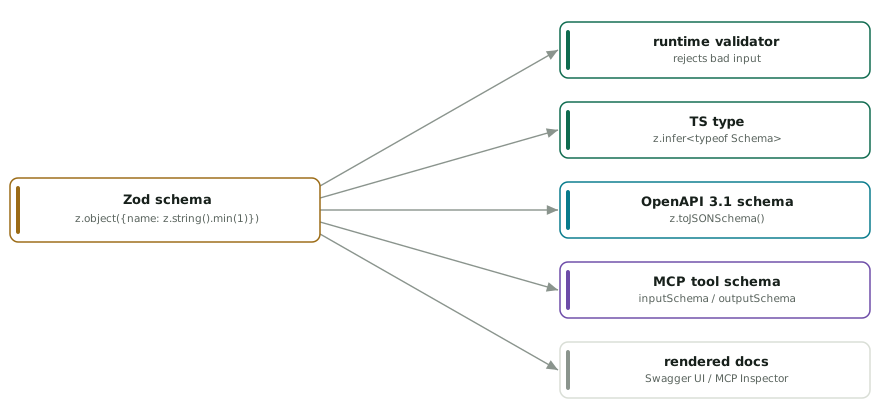
diagram source (mermaid)
graph LR
Z["z.object({ name: z.string().min(1) })"]
Z --> V["runtime validator<br/>(rejects bad input)"]
Z --> T["TS type<br/>z.infer<typeof Schema>"]
Z --> O["OpenAPI 3.1 schema<br/>z.toJSONSchema()"]
Z --> M["MCP inputSchema /<br/>outputSchema"]
Z --> D["Swagger UI / MCP Inspector<br/>rendered docs"]There is no second source of truth. Change the schema and the handler's parameter type changes (TS error if your code disagrees), the OpenAPI document changes, the MCP tool definition changes, and the validation changes — together, in one edit. This is the framework's core bet; the design thesis explains why it matters so much for AI-led and large teams.
REST: schemas on the verb decorator
import {z} from 'zod';
import {api, get, post} from '@agentback/openapi';

const HelloPath = z.object({name: z.string().min(1).max(64)});
const Greeting = z.object({greeting: z.string()});
const EchoIn = z.object({text: z.string().min(1).max(280)});
const EchoOut = z.object({echoed: z.string(), at: z.string()});

@api({basePath: '/greet'})
class GreetingController {
  @get('/hello/{name}', {path: HelloPath, response: Greeting})
  async hello(input: {path: z.infer<typeof HelloPath>}) {
    return {greeting: `Hello, ${input.path.name}!`};
  }

  @post('/echo', {body: EchoIn, response: EchoOut})
  async echo(input: {body: z.infer<typeof EchoIn>}) {
    return {echoed: input.body.text, at: new Date().toISOString()};
  }
}
The verb decorators (@get, @post, @put, @patch, @del) take a path and
an options object. The schema slots are:
| Option | Validates | Appears in OpenAPI as |
|---|---|---|
path |
URL path parameters | path parameters |
query |
query string | query parameters |
headers |
request headers (use lowercase keys) | header parameters |
body |
request body | request body |
response |
the handler's return value | the 200 (or status) response |
status |
— (a number) | overrides the default 200; 204 sends no body |
MCP: schemas on @tool
import {z} from 'zod';
import {mcpServer, tool} from '@agentback/mcp';

const ForecastIn = z.object({
  city: z.string(),
  days: z.number().int().min(1).max(7),
});
const ForecastOut = z.object({city: z.string(), forecast: z.string()});

@mcpServer()
class WeatherTools {
  @tool('get_forecast', {
    description: 'Forecast for a city',
    input: ForecastIn,
    output: ForecastOut,
  })
  async getForecast(input: z.infer<typeof ForecastIn>) {
    return {city: input.city, forecast: 'sunny'};
  }
}
@tool's input/output play the same role as REST's body/response: the
input is validated and typed via z.infer; if output is declared, the return
type is constrained at compile time, validated at runtime, and handed to the
MCP SDK so structured-content clients consume it directly.
The handler signature
This is the one rule worth memorizing, and it's identical in spirit for REST and MCP.
Slot 0 = the validated input bundle (when any schema is declared)
For REST, slot 0 is an object with only the keys you declared:
@post('/things/{id}', {path: IdPath, body: ThingBody, query: ThingQuery})
async create(input: {
  path: z.infer<typeof IdPath>;
  body: z.infer<typeof ThingBody>;
  query: z.infer<typeof ThingQuery>;
}) { … }
For MCP, slot 0 is the inferred input directly:
@tool('add', {input: AddIn})
async add(input: z.infer<typeof AddIn>) { … }
The decorator's typing enforces this at compile time. If your parameter type disagrees with the declared schemas, you get a TypeScript error at the decorator line, with the mismatch surfaced precisely.
Slot 0 is yours when no schemas are declared
@get('/whoami')
async whoami(@inject(SecurityBindings.USER) user: UserProfile) { … } // valid

@tool('ping')
async ping() { … } // valid
@inject lives at slot 1+
When you declare schemas, dependencies inject at the second parameter onward — slot 0 is reserved for the input bundle:
@post('/echo', {body: EchoIn, response: EchoOut})
async echo(
  input: {body: z.infer<typeof EchoIn>},        // slot 0
  @inject('services.Clock') clock: Clock,        // slot 1+
) {
  return {echoed: input.body.text, at: clock.now()};
}
Putting @inject at slot 0 alongside a schema throws at decoration time with
the offending class+method named.
Validation, in and out
- Input is parsed with the schema before your handler runs. On failure the
request never reaches your code:
- REST returns 422 (bad body) / 400 (bad params) with the structured
ZodError.issuesin the response. - MCP throws, and the call surfaces the issues to the client.
- REST returns 422 (bad body) / 400 (bad params) with the structured
- Output is validated against
response/outputafter your handler returns. On mismatch: REST logs it (and still responds), MCP throws — the asymmetry is intentional (a REST API shouldn't 500 on a doc drift, an MCP tool contract should be strict).
Startup checks
Some coherence is verified when app.start() runs, not at request time:
- URL placeholders must match the
pathschema keys.@get('/hello/{name}', {path: z.object({name: …})})is fine; a{id}in the URL with noidin the schema throws at startup, naming the controller + method.
This turns a class of "wrong at runtime, in production" bugs into "wrong at boot, in the first test."
Where it's wired (for the curious)
- REST verb decorators store route options on
RestEndpointmetadata plus a per-route Zod bundle inzod-bridge.ts'srouteRegistry.RestServerreads the registry, validates, and weaves@injectarguments viaresolveInjectedArguments. @toolstoresinput/outputonToolMetadata.MCPServer.dispatchToolparses input, weaves injects, applies the method, validates output.
You don't need to touch those to use the framework, but it's a short read if you want to extend the dispatcher — see Composition & extensibility.