Architecture overview
How the pieces fit, how a request flows, and how the packages layer. If you've read the concepts, this ties them together.
A polished, standalone version of the system diagram below lives at
diagrams/system-architecture.html— open it in a browser.
The system at a glance
Everything is a binding in one Context. The servers are bindings too; they
discover your code by tag at startup and expose it over their transport. The
same Zod schemas feed validation, OpenAPI, and MCP contracts.
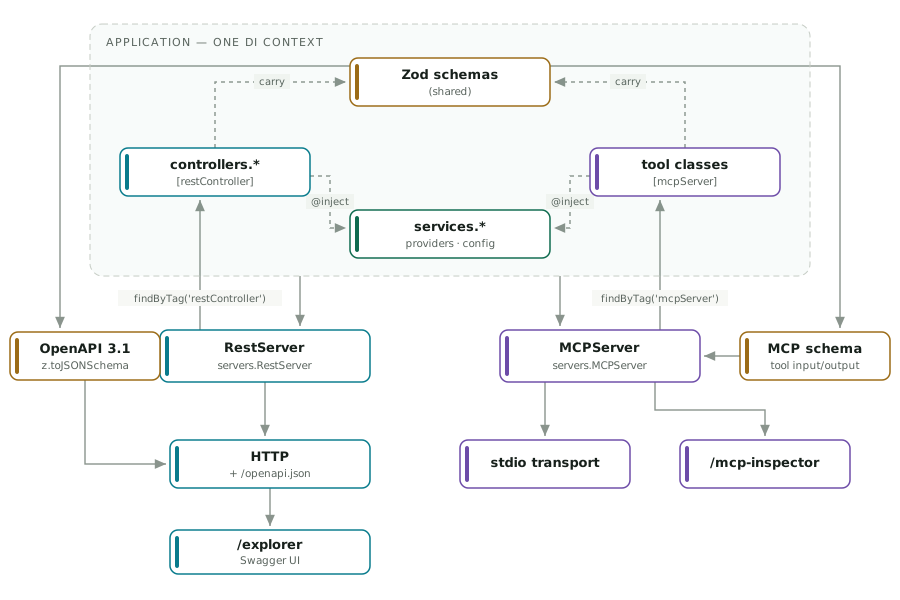
diagram source (mermaid)
graph TD
  subgraph Container["Application — one DI Context"]
    direction TB
    Schemas["Zod schemas (shared)"]
    Ctrls["controllers.* [controller]"]
    Tools["tool classes [mcpServer]"]
    Svcs["services.* / providers / config"]
    Ctrls -. @inject .-> Svcs
    Tools -. @inject .-> Svcs
    Ctrls -. carry .-> Schemas
    Tools -. carry .-> Schemas
  end
  Container --> RS["RestServer<br/>(servers.RestServer)"]
  Container --> MS["MCPServer<br/>(servers.MCPServer)"]
  RS -->|findByTag controller| Ctrls
  MS -->|findByTag mcpServer| Tools
  RS --> HTTP["HTTP + /openapi.json"]
  HTTP --> SUI["/explorer (Swagger UI)"]
  MS --> STDIO["stdio transport"]
  MS --> INS["/mcp-inspector"]
  Schemas --> OAS["OpenAPI 3.1 (z.toJSONSchema)"]
  Schemas --> MCPC["MCP input/output schema"]
  OAS --> HTTP
  MCPC --> MS
The shape to remember: one container in the middle; servers on the edges discovering bindings by tag; schemas radiating out to every contract.
How a REST request flows
Two standalone diagrams cover the middleware layer: the structure — the group-sorted cascade (
cors → parseBody → middleware) that fronts every route — atdiagrams/middleware-chain.html, and a live request trace through the resolved order (POST/mcp①→⑦, plus the OPTIONS-preflight short-circuit) atdiagrams/mcp-request-lifecycle.html. Open them in a browser.
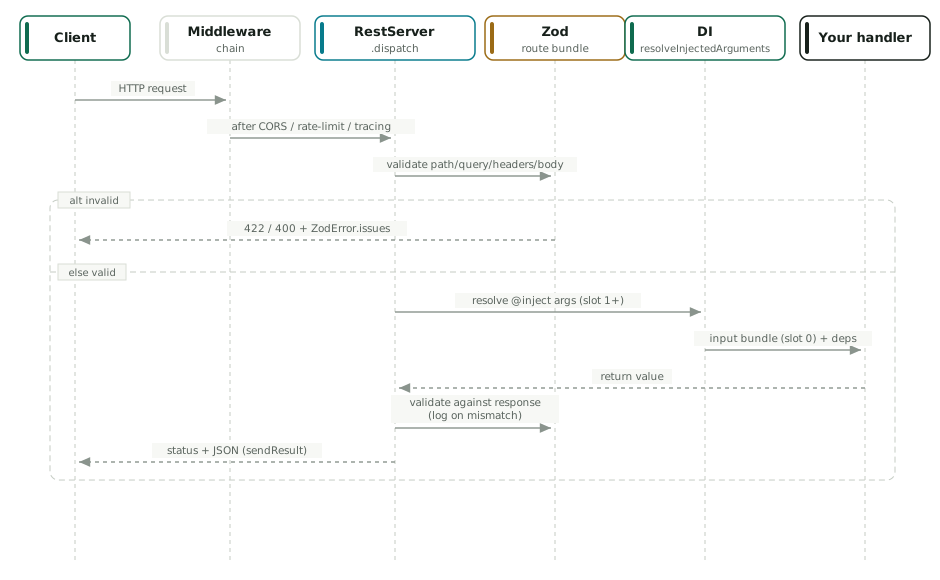
diagram source (mermaid)
sequenceDiagram
  participant C as Client
  participant MW as Middleware chain
  participant RS as RestServer.dispatch
  participant Z as Zod (route bundle)
  participant DI as resolveInjectedArguments
  participant H as Your handler
  C->>MW: HTTP request
  MW->>RS: (after CORS / rate-limit / tracing)
  RS->>Z: validate path/query/headers/body
  alt invalid
    Z-->>C: 422 / 400 + ZodError.issues
  else valid
    RS->>DI: resolve @inject args (slot 1+)
    DI->>H: input bundle (slot 0) + deps
    H-->>RS: return value
    RS->>Z: validate against `response` (log on mismatch)
    RS-->>C: status + JSON (sendResult)
end- Middleware runs first and can short-circuit (preflights, throttling, probes).
- Validation happens before your code — a bad request never reaches the handler.
- Injection weaves dependencies at slot 1+; the validated input bundle is slot 0.
dispatch/sendResult/sendErrorare theprotectedseams you subclass to reshape the pipeline.
An MCP tool call follows the analogous path inside MCPServer.dispatchTool:
parse input → weave injects → apply method → validate output.
Protocol eras: one endpoint, two revisions
Since 0.9.0 the default is protocol: 'both' — the SDK's createMcpHandler
serves the 2026-07-28 revision and 2025-era traffic from the same URL,
picking per request. dispatchTool above is unchanged either way; the era only
decides how a call arrives.
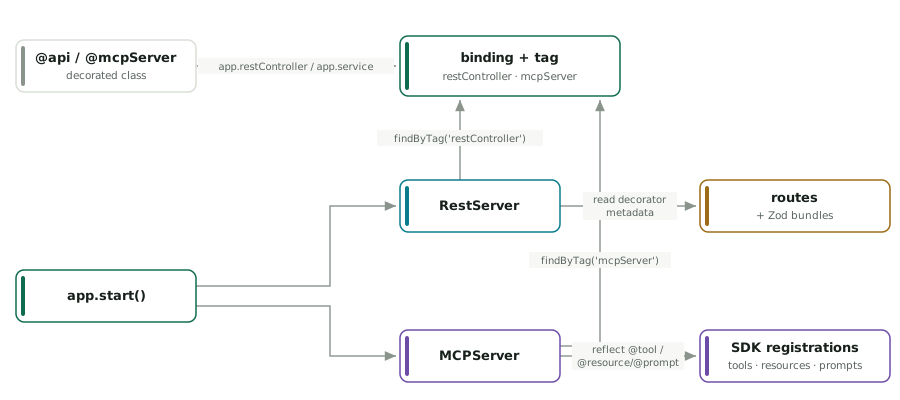
diagram source (mermaid)
graph TD
  C26["2026-07-28 client"] --> EP["POST /mcp"]
  C25["2025-era client<br/>(SDK 1.11 – 1.29)"] --> EP
  EP --> H{"protocol"}
  H -->|"'both' — DEFAULT"| SL["createMcpHandler<br/>one server per REQUEST"]
  H -->|"'legacy' — rollback"| SS["StreamableHTTPServerTransport<br/>one server per SESSION"]
  SL --> D["MCPServer.dispatchTool<br/>(identical on both paths)"]
  SS --> D
  SL -.->|"no Mcp-Session-Id<br/>GET/DELETE → 405<br/>perSession runs per request"| N1[" "]
  SS -.->|"Mcp-Session-Id minted<br/>eventStore replay works<br/>perSession runs once"| N2[" "]
  style SL fill:#dff0d8,stroke:#3c763d
  style N1 fill:none,stroke:none
  style N2 fill:none,stroke:none
Both client boxes reach both paths — that is the compatibility claim, and it is
verified against three released 1.x SDKs rather than asserted. The one asymmetry
worth remembering: eventStore (resumable SSE) exists only on the session path,
so configuring it without naming a protocol keeps you on 'legacy'.
Stdio has the same switch and the same default, via serveStdio, with the era
pinned per connection instead of per request.
How HTTP hosts work
A polished, standalone version of the hosts diagram below lives at
diagrams/http-hosts.html— open it in a browser.
The dispatch pipeline above is host-agnostic. RestServer.fetchHandler()
exposes it as one runtime-neutral fetch(Request): Response — the same routing,
validation, DI, auth, hooks, streaming, uploads, and error envelopes the Express
server runs. Whatever owns the TCP port (Node, Fastify, Hono, Bun, Deno,
Workers) bridges its native request to that one handler.
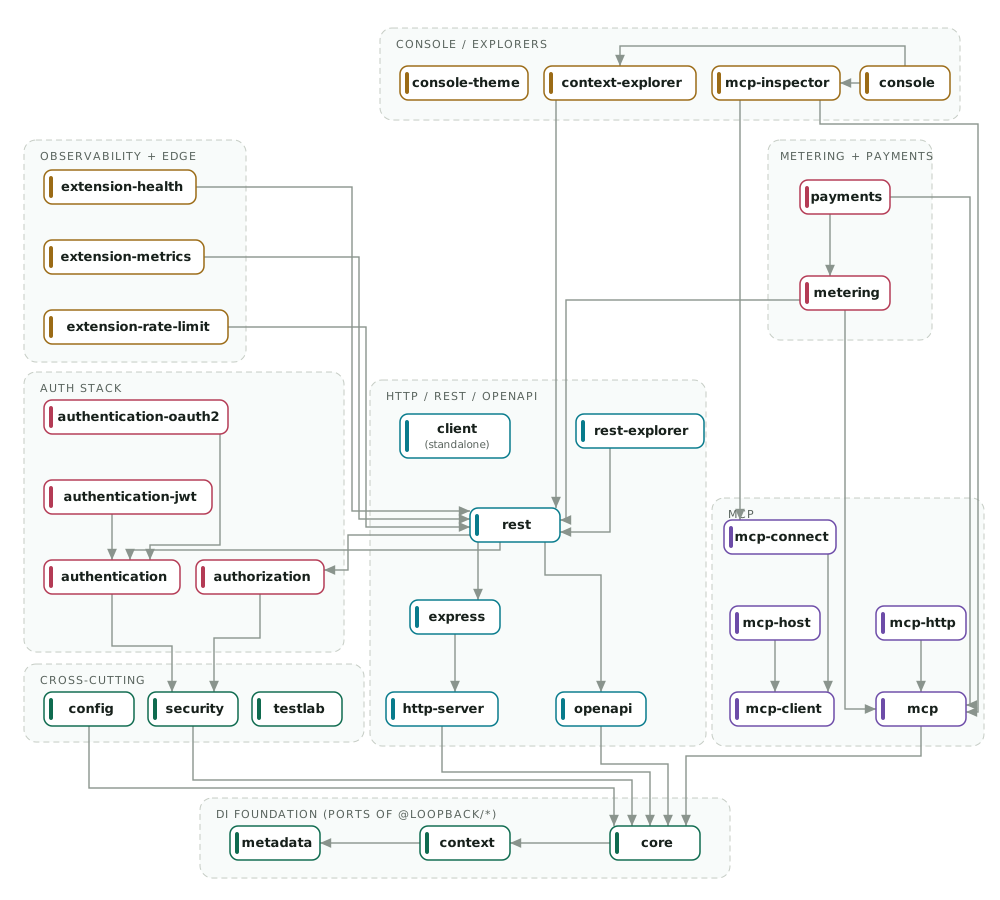
diagram source (mermaid)
graph TD
  subgraph Core["RestServer"]
    RH["RestHandler pipeline<br/>auth → validate → DI → output"]
    FH["fetchHandler()<br/><b>fetch(Request): Response</b>"]
    RH --> FH
  end
  FH --> Express["Express listener<br/>(default)"]
  FH --> Native["Node http<br/>listener: 'native'"]
  FH --> Fastify["installFastifyHost"]
  FH --> Hono["hono.all('*', …)"]
  FH --> Bun["Bun.serve({fetch})"]
  FH --> Edge["Deno / Workers"]
  MCP["mountMcpHttpFetch<br/>(MCP-over-HTTP)"] --> FH
  UIs["install* UIs +<br/>/openapi.json · /llms.txt"] --> FH
Two registration seams extend the fetch surface beyond @api routes:
addFetchHandler(method, path, fn) (exact paths — the framework docs, UI
shells) and addFetchPrefix(prefix, fn) (static asset dirs). mountMcpHttpFetch
uses them to put MCP-over-HTTP on the same handler, so a single host serves
REST, MCP, the OpenAPI document, and the dev console together.
- Default (
listener: 'express') — Express owns routing; everything works, including raw@inject(HTTP_REQUEST/HTTP_RESPONSE)routes. listener: 'native'— the Node listener servesfetchHandler()directly; the Router is the single source of truth (parity with how Bun/Fastify/Hono host it).start()rejects Express-coupled routes up front.
The runnable four-host comparison is
examples/hello-hosts; the deploy
snippets are in HTTP hosts.
How discovery works
No router file, no central switch. Servers find your code by querying the container at start time.
diagram source (mermaid)
graph LR
  Dec["@api + @mcpServer class"] -->|"app.restController (one call)"| Bind["one binding + tags<br/>(controller · extensionFor MCP_SERVERS)"]
  Start["app.start()"] --> SrvR["RestServer"]
  Start --> SrvM["MCPServer"]
  SrvR -->|"findByTag('controller')"| Bind
  SrvM -->|"findByTag('mcpServer')"| Bind
  SrvR -->|read decorator metadata| Routes["routes + Zod bundles"]
  SrvM -->|reflect @tool/@resource/@prompt| Reg["SDK registrations"]
This is why "add a feature" = "add a binding": the discovery step picks it up with zero wiring.
Package layering
The DI foundation is the base; servers, integrations, and the agent runtime
build up from it. Every package has its own README.md with exports and a usage
snippet. An arrow means "depends on."
diagram source (mermaid)
graph BT
  subgraph foundation["DI foundation (ports of @loopback/*)"]
    metadata["metadata"]; context["context"]; core["core"]
  end
  subgraph crosscut["cross-cutting"]
    config["config"]; security["security"]; testlab["testlab"]
  end
  subgraph http["HTTP / REST / OpenAPI"]
    httpserver["http-server"]; express["express"]; openapi["openapi"]
    rest["rest"]; restexp["rest-explorer"]; client["client (standalone)"]
  end
  subgraph auth["auth stack"]
    authn["authentication"]; authjwt["authentication-jwt"]
    authoauth2["authentication-oauth2"]; authz["authorization"]
  end
  subgraph pay["metering + payments"]
    metering["metering"]; payments["payments"]
  end
  subgraph mcpfam["MCP"]
    mcp["mcp"]; mcphttp["mcp-http"]
    mcpclient["mcp-client"]; mcphost["mcp-host"]; mcpconnect["mcp-connect"]
  end
  subgraph obs["observability + edge"]
    health["extension-health"]; metrics["extension-metrics"]
    ratelimit["extension-rate-limit"]
  end
  subgraph ui["console / explorers"]
    theme["console-theme"]; ctxexp["context-explorer"]
    schemaexp["schema-explorer"]; mcpins["mcp-inspector"]; console["console"]
  end
  context --> metadata
  core --> context
  config --> core
  security --> core
  httpserver --> core
  express --> httpserver
  openapi --> core
  rest --> express
  rest --> openapi
  rest --> authn
  rest --> authz
  authn --> security
  authjwt --> authn
  authoauth2 --> authn
  authz --> security
  metering --> rest
  metering --> mcp
  payments --> metering
  payments --> mcp
  mcp --> core
  mcphttp --> mcp
  mcphost --> mcpclient
  mcpconnect --> mcpclient
  restexp --> rest
  health --> rest
  metrics --> rest
  ratelimit --> rest
  ctxexp --> rest
  schemaexp --> rest
  schemaexp --> mcp
  mcpins --> mcp
  mcpins --> mcpconnect
  console --> mcpins
  console --> ctxexp
  console --> schemaexp
Notes:
metadata → context → coreis the DI foundation, a faithful ESM port of@loopback/{metadata,context,core}. Know LB4 DI and you know this layer.corere-exportscontext, which re-exportsmetadata— most consumers only import@agentback/core.openapi,rest,mcpare rewrites (see the design pivots).config,securityare cross-cutting; the auth stack (authentication,authentication-jwt,authentication-oauth2,authorization) builds onsecurityand is woven intorest's dispatch pipeline.metering,paymentssubclass the dispatchers to count every call (metered?) and gate/bill the paid ones (paid?— x402 / MPP / Stripe). They hang off the principal the auth stack produces — see metering & payments.clientdepends on none of the above — it only needszod, so it's browser-safe and shares schemas with the server without importing the server.- The MCP client family (
mcp-client,mcp-host,mcp-connect) is a standalone path for consuming upstream MCP servers, distinct frommcp(which serves tools). - The UI packages (
rest-explorer,mcp-inspector,context-explorer,schema-explorer,console) mount on a running server;console-themeis shared styling.schema-explorerreads bothrestandmcp— it indexes the app by Zod schema and joins each entity to the routes and tools that use it (the inverse of the per-protocol explorers).
Agent-facing runtime pieces
The packages in this repo stop at framework and substrate boundaries. They give agent applications the core primitives for tools, durable work, gatewaying, and plugins, but they do not currently ship a higher-level turn loop or orchestration runtime.
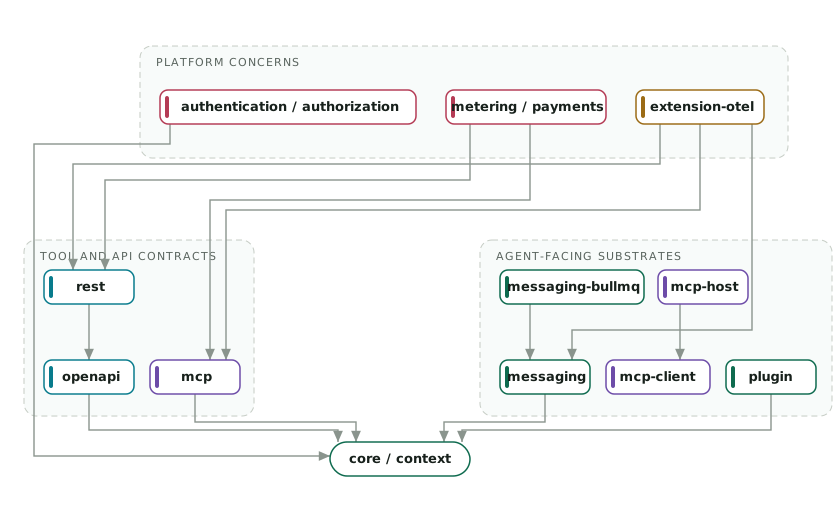
diagram source (mermaid)
graph BT
  subgraph contracts["tool and API contracts"]
    openapi["openapi"]; mcp["mcp"]; rest["rest"]
  end
  subgraph runtime["agent-facing substrates"]
    messaging["messaging"]; bullmq["messaging-bullmq"]
    mcphost["mcp-host"]; mcpclient["mcp-client"]; plugin["plugin"]
    files["files"]; filess3["files-s3"]
  end
  subgraph platform["platform concerns"]
    auth["authentication / authorization"]
    metering["metering / payments"]
    otel["extension-otel"]
  end
  core(["core / context"])
  openapi --> core
  rest --> openapi
  mcp --> core
  messaging --> core
  bullmq --> messaging
  files --> core
  filess3 --> files
  rest --> files
  mcphost --> mcpclient
  plugin --> core
  auth --> core
  metering --> rest
  metering --> mcp
  otel --> rest
  otel --> mcp
otel --> messaging- Tool serving —
mcpexposes decorated tool classes over MCP, with the same Zod schemas used for runtime validation and tool contracts. - Tool consumption —
mcp-clientandmcp-hostconnect to and aggregate upstream MCP servers. - Durable work —
messagingdefines Zod-typedJobQueue,EventBus,Scheduler, andQueueAdminports;messaging-bullmqimplements those ports over BullMQ and Redis Streams. - Runtime extension —
plugindiscovers and gates components;metering,payments, andextension-otelcompose via dispatcher hooks and server seams.
Where the boundaries are the same artifact
The thing that distinguishes this framework: a single Zod schema is the
validator, the z.infer type, the OpenAPI parameter/response, the MCP
input/output, and the rendered docs — simultaneously. Changing it changes all of
them in one edit, and disagreements surface as a TypeScript error at the
decorator, a startup throw, or a failing test — three localized
signals instead of one vague one.
That property, not any single feature, is the framework's bet. The full argument is in the boundary-coherence design thesis.
Next
- Back to the concepts or guides.
- The design thesis for the "why."