Concept: Dependency Injection
The DI container is the foundation the entire framework stands on. REST and MCP are just two ways to expose bindings that live in it. Understand this layer and the rest of the framework becomes "bind a class, tag it, a server finds it."
Packages:
@agentback/context(the container) and@agentback/core(Application, which is a context). The DI semantics match@loopback/context/@loopback/coreexactly — if you know LoopBack 4 DI, you already know this.
The three nouns
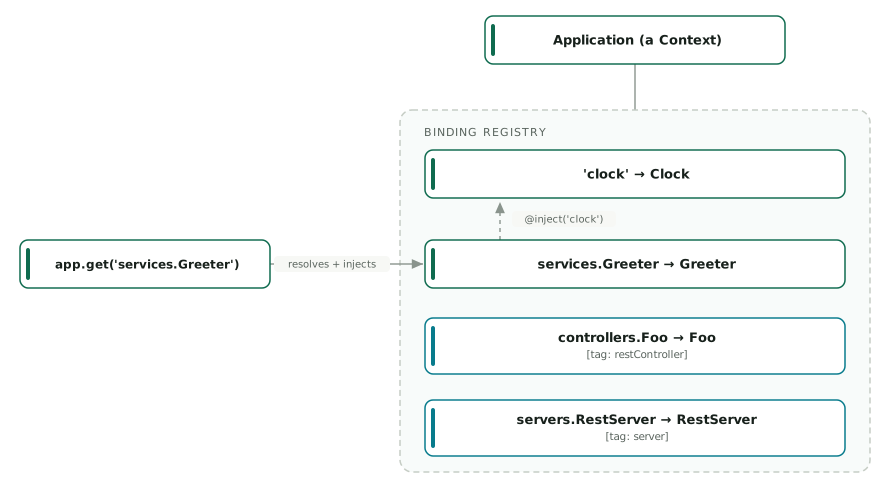
diagram source (mermaid)
graph TD
  App["Application (a Context)"]
  subgraph Registry["binding registry"]
    B1["'clock' → Clock"]
    B2["services.Greeter → Greeter"]
    B3["controllers.Foo → Foo  [tag: controller]"]
    B4["servers.RestServer → RestServer  [tag: server]"]
  end
  App --- Registry
  Resolve["app.get('services.Greeter')"] -->|"resolves + injects deps"| B2
B2 -.->|"@inject('clock')"| B1Context— a registry of bindings plus a resolver. Contexts form a hierarchy (an app context, a per-server child, a per-request child); a lookup walks up the chain.Binding— maps a key (e.g.services.Greeter) to a value source (a constant, a class, a provider, an alias) with a scope and a set of tags.@inject— declares, on a constructor parameter or property, which binding supplies a value. The container resolves and injects it.
The key mental model: the Application is itself a Context. app.bind(...),
app.get(...), app.find(...) are Context methods. Servers, components, your
controllers — all bindings in that one container.
Binding a value
import {Application} from '@agentback/core';
import {BindingScope} from '@agentback/context';

const app = new Application();

// a constant
app.bind('config.apiBase').to('https://api.example.com');

// a class (constructed lazily, deps injected)
app.bind('services.Clock').toClass(Clock);

// a provider (a class with a value() method, for async/computed values)
app.bind('services.Token').toProvider(TokenProvider);

// an alias (another binding's value, by key)
app.bind('services.Now').toAlias('services.Clock');

// a dynamic value (recomputed each resolution unless scoped)
app.bind('now').toDynamicValue(() => Date.now());
Resolve with await app.get(key) (async — providers may be async) or
app.getSync(key) when you know the value is synchronous.
Scopes — how often a value is created
Set with .inScope(...) or the @injectable({scope}) decorator. The ones you
will actually use:
| Scope | Meaning |
|---|---|
TRANSIENT (default) |
A fresh value on every resolution. |
SINGLETON |
One value for the whole application, cached on the owning context. |
CONTEXT |
One value per context that resolves it (e.g. per request when resolved from a request context). |
import {injectable, BindingScope} from '@agentback/context';

@injectable({scope: BindingScope.SINGLETON})
class Clock {
  now() {
    return new Date().toISOString();
  }
}
app.bind('services.Clock').toClass(Clock); // honors the @injectable scope
Other scopes (APPLICATION, SERVER, REQUEST) exist for advanced
hierarchical setups; default to TRANSIENT for stateless logic and SINGLETON
for shared state or expensive construction.
@inject — declaring dependencies
@inject works on constructor parameters and properties. The value is resolved
when the owning binding is constructed.
import {inject} from '@agentback/context';

class Greeter {
  // constructor injection (preferred)
  constructor(@inject('services.Clock') private clock: Clock) {}

  greet(name: string) {
    return `Hello ${name} at ${this.clock.now()}`;
  }
}
Typed binding keys
A plain string key is untyped. BindingKey.create<T>() ties a key to a type so
@inject and app.get are type-checked and discoverable:
import {BindingKey} from '@agentback/context';

export const CLOCK = BindingKey.create<Clock>('services.Clock');

app.bind(CLOCK).toClass(Clock);
class Greeter {
  constructor(@inject(CLOCK) private clock: Clock) {} // Clock inferred
}
This is the recommended pattern for anything you expose for others to inject — it turns "what's behind this string?" into a go-to-definition.
@inject variants
| Variant | Injects |
|---|---|
@inject(key) |
The resolved value. |
@inject(key, {optional: true}) |
The value, or undefined if unbound (no throw). |
@inject.getter(key) |
A () => Promise<T> you call later (defers resolution). |
@inject.setter(key) |
A (value) => void to rebind at runtime. |
@inject.tag(tag) |
An array of all values whose binding carries tag. |
@inject.view(filter) |
A live ContextView that updates as matching bindings come and go. |
@inject.context() |
The owning Context itself (use sparingly). |
@config() |
The configuration bound for the current binding (see below). |
@inject.tag is the workhorse of extensibility — see
Composition & extensibility.
Tags and discovery
A binding can carry tags (name/value pairs). The framework finds bindings by tag instead of by hard-coded references — this is how servers locate your code without you registering it in a router.
app.bind('controllers.Foo').toClass(Foo).tag('controller');

// find everything tagged — what RestServer does at startup
const controllers = app.findByTag('controller'); // Binding[]
You rarely call .tag() by hand. The class decorators put the tag in metadata,
and the registration helpers apply it for you:
| Helper | Tag applied | Found by |
|---|---|---|
app.controller(C) |
controller (+ extensionFor: MCP_SERVERS if @mcpServer()) |
RestServer |
app.restController(C) |
controller — a thin alias for app.controller(C) |
RestServer |
app.service(C) |
service (+ extensionFor: MCP_SERVERS if @mcpServer()) |
DI / MCP server |
app.component(C) |
— (registers the component's bindings) | — |
app.server(C) |
server |
Application lifecycle |
@mcpServer() is built on @injectable: it tags the class
extensionFor: MCP_SERVERS (and defaults it to singleton scope); when you
app.service(WeatherTools), the framework reads that metadata and tags the
binding automatically — see the
MCP guide.
Register tool classes with app.service(C) — a tool is a service. The MCP
server discovers it as an MCP_SERVERS extension and resolves the instance
through its binding, so constructor @inject is honored regardless of namespace
(service, controller, or a manual bind().apply(extensionFor(MCP_SERVERS))).
A dual REST + MCP class (@api + @mcpServer) needs only one registration:
app.restController(C) (or app.controller(C)) tags it controller so
RestServer mounts its routes, and — because the helper honors the class's
@mcpServer metadata — keeps its extensionFor: MCP_SERVERS membership so the
MCP server discovers its tools. Don't also app.service(C) the same class:
explicit calls keep separate bindings, which would register the tool twice.
Configuration
Any binding can have a sidecar configuration binding. Inject it with @config():
import {config} from '@agentback/context';

class MailService {
  constructor(@config() private cfg: {from: string}) {}
}
app.bind('services.Mail').toClass(MailService);
app.configure('services.Mail').to({from: 'noreply@example.com'});
Servers use exactly this mechanism: app.configure('servers.RestServer').to({port: 3000}).
Why this matters for composition
Because every capability is a binding discovered by tag:
- Adding a feature never edits central code. A new controller, tool, auth strategy, or health check is a new binding. Nothing downstream changes.
- Swapping for tests is one line.
app.bind('services.Clock').to(fakeClock)overrides the real one; no module-mock machinery. - Reasoning stays local. A class declares its dependencies in its constructor. There's no hidden global to trace.
These properties are what the composition guide builds on, and why the framework scales to multi-team / plugin / AI-tool surfaces.
Standalone use
You don't need HTTP or MCP to use the container. It's a fine general-purpose DI system for any Node app:
const app = new Application();
app.bind('services.Clock').toClass(Clock);
app.service(Greeter);
const greeter = await app.get<Greeter>('services.Greeter');
console.log(greeter.greet('world'));
Next
- Schema-first decorators — how routes and tools are declared on top of this container.
- Components, servers & lifecycle — how the servers themselves are bindings.