Metering & payments
How every REST and MCP call gets counted (and attributed to a billable identity), and how the calls that must be paid for get gated or billed. Two small packages sit on top of the dispatch seams:
@agentback/metering— the metered? answer: aMeteremits aUsageEventper call into pluggable sinks (the durable one is your audit log), plus a per-principalQuotaService.@agentback/payments— the paid? answer: aPaymentRailseam with x402 (per-call HTTP 402), MPP (pre-authorized sessions), and Stripe (usage-log metered billing).
A polished, standalone version of the diagram below lives at
diagrams/metering-and-payments.html— open it in a browser.
This is the framework realization of three questions an enforcement point asks
per call — may-call? (policy, the auth stack),
paid? (rail), metered? (billing). Auth answers the first; these two packages
answer the other two, and both hang off the principal the auth layer already
produces.
Metering data flow
Every call crosses one of two protected dispatch seams. A metered subclass
wraps it, times the call, and records a UsageEvent attributed to the
request's principal.
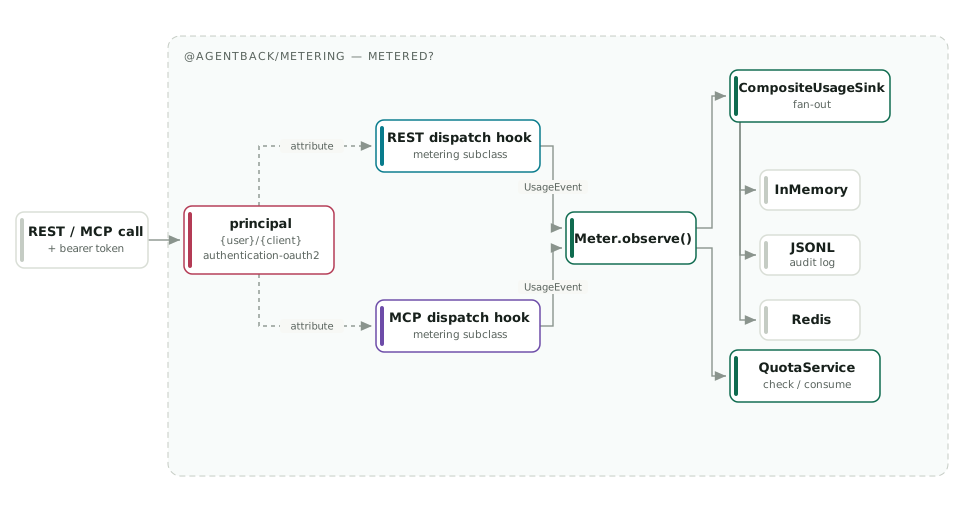
diagram source (mermaid)
graph LR
  Call["REST / MCP call<br/>+ bearer token"]
  subgraph metering["@agentback/metering — metered?"]
    direction LR
    P["principal {user}/{client}<br/>(authentication-oauth2)"]
    RS["metering REST dispatch hook"]
    MS["metering MCP dispatch hook"]
    M["Meter.observe()"]
    C["CompositeUsageSink"]
    Q["QuotaService"]
    InMem["InMemory"]; JSONL["JSONL (audit)"]; Redis["Redis"]
  end
  Call --> P
  P -. attribute .-> RS
  P -. attribute .-> MS
  RS -->|UsageEvent| M
  MS -->|UsageEvent| M
  M --> C
  M --> Q
  C --> InMem
  C --> JSONL
  C --> Redis
The shape to remember: the auth principal is the billable identity; the
metered server is a thin subclass over the existing dispatch; one UsageEvent
fans out to as many sinks as you bind.
The seams
RestServer.dispatch / sendResult / sendError and MCPServer.dispatchTool
are protected (see composition & extensibility).
The metered servers subclass them and emit around the base call:
import {MeteredRestServer, MeteringComponent} from '@agentback/metering';

const app = new RestApplication({});
app.server(MeteredRestServer, 'RestServer'); // replaces the default at the same key
app.component(MeteringComponent); // in-memory sink + quota + Meter
MeteredMCPServer does the same for tools. With no Meter bound, both behave
exactly like their base server — safe to install unconditionally. The principal
is read from the auth result (REST) or the request context (MCP), so a metered
call carries {user}/{client} even though authentication runs inside the
wrapped dispatch.
The event
interface UsageEvent {
  id: string; // ulid; also the idempotency key for sinks
  at: string; // ISO timestamp
  principal: {kind: 'user' | 'client' | 'anonymous'; id: string};
  surface: 'rest' | 'mcp';
  operation: string; // 'Controller.method' or tool name
  status: 'ok' | 'error' | 'denied' | 'rate_limited' | 'payment_required';
  latencyMs: number;
  units: number; // billable units (default 1)
  cost?: {amount: string; currency: string}; // priced downstream, not here
}
status is what makes the log an audit trail rather than a counter: a refused
call (denied/rate_limited/payment_required) is recorded with why, but
not billed. units is the seam between "a call happened" and "a call cost N";
the price lives downstream.
Sinks
A UsageSink is just record(event). Pick one, or fan out with
CompositeUsageSink:
| Sink | Durability | Use |
|---|---|---|
InMemoryUsageSink |
process-local, queryable | dev, tests, the buffer behind a flushing sink |
JsonlUsageSink |
append-only file, replayable | the durable audit log (rung-1 asset) |
RedisUsageSink |
shared across processes | multi-instance deployments (SADD-deduped) |
CompositeUsageSink |
fan-out | record to audit and bill from one event |
All sinks are idempotent on UsageEvent.id, so replaying a log is safe.
Quota
QuotaService.check(principalId) / consume(...) is the metered? enforcement
arm — per-principal limits, independent of any rail. The default
InMemoryQuotaService is a cumulative counter vs a limit map; a windowed or
prepaid-credit policy is a downstream implementation of the same interface.
See
examples/hello-oauth2: it swaps inMeteredRestServer, andGET /admin/usageprints the recorded events —user:user-alice ok,client:svc-importer ok,user:user-bob denied(403),anonymous denied(401). The auth principal flows all the way to attributed usage.
Payment rails
Two kinds of rail, deliberately different shapes:
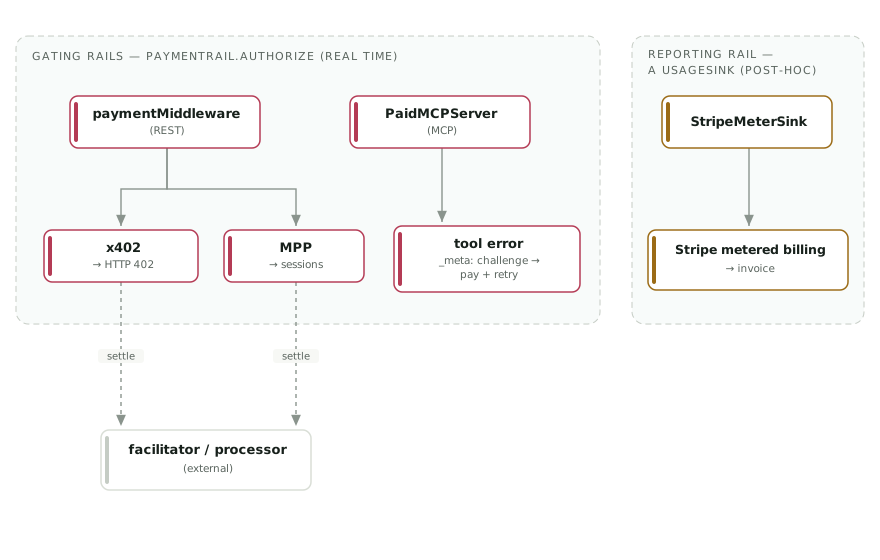
diagram source (mermaid)
graph TD
  subgraph gate["Gating rails — PaymentRail.authorize (real time)"]
    PM["paymentMiddleware (REST)"] --> X["x402 → HTTP 402"]
    PM --> MPP["MPP → sessions"]
    PMCP["PaidMCPServer (MCP)"] --> TE["tool error<br/>_meta: challenge → pay + retry"]
  end
  subgraph report["Reporting rail — a UsageSink (post-hoc)"]
    SMS["StripeMeterSink"] --> SB["Stripe metered billing → invoice"]
  end
  X -. settle .-> F["facilitator / processor (external)"]
MPP -. settle .-> F- Gating rails answer
paid?at call time.PaymentRail.authorize(ctx)returns either apaidreceipt or apayment_requiredchallenge. - The reporting rail (Stripe) does not gate — it forwards billable events
to Stripe, which invoices on its own cycle. It is a
UsageSink, not aPaymentRail.
We orchestrate, we don't settle: every rail delegates the on-chain transfer or card movement to an external facilitator/processor, injected as an interface (and faked in tests).
x402 (per-call HTTP 402)
import {X402Rail, paymentMiddleware} from '@agentback/payments';

const rail = new X402Rail({
  facilitator,
  requirements: ctx => [/* PaymentRequirements */],
});
restServer.expressApp.post('/premium', paymentMiddleware(rail), handler);
No X-PAYMENT header → 402 + the accepts requirements. A presented payment
is verify-ed and settle-d through the facilitator; success sets
X-PAYMENT-RESPONSE and runs the handler. Best for the long tail of cheap
calls. See examples/hello-x402 for the full 402 → pay → 200 flow against an
in-process fake facilitator.
MPP (pre-authorized sessions)
import {MppRail, InMemoryMppSessionStore} from '@agentback/payments';

const store = new InMemoryMppSessionStore();
store.open({id: 'sess_1', limit: 1000, spent: 0}); // processor opens this out of band
const rail = new MppRail({store, cost: () => 1}); // callers send X-MPP-SESSION
Instead of settling per call, MPP streams against a pre-authorized budget — an
MPP session is the per-principal budget the QuotaService models. Missing /
expired / exhausted → 402 with an MPP challenge. The natural MCP rail (no
per-call round-trip).
Stripe (usage-log metered billing)
The enterprise path — fiat, no crypto, no gating. StripeMeterSink is a
UsageSink that forwards billable events to Stripe. Compose it with the audit
sink so one event both records and bills:
app
  .bind(MeteringBindings.SINK)
  .to(
    new CompositeUsageSink([
      new JsonlUsageSink('usage.jsonl'),
      new StripeMeterSink(reporter),
    ]),
  );
Only status: 'ok' bills by default; the event id is the Stripe idempotency
identifier, so re-reporting a log is safe.
Paying for MCP tools
MCP is JSON-RPC — there is no HTTP 402. So a paid tool called without proof
returns a tool error carrying the challenge in _meta; the agent reads it,
pays, and retries. PaidMCPServer wires it, and over MCP-over-HTTP it is
end-to-end with no per-app glue — the proof travels in request headers
(X-PAYMENT / X-MPP-SESSION), exposed to tools via MCPBindings.REQUEST_INFO:
import {PaidMCPServer, PaymentMcpBindings} from '@agentback/payments';

app.server(PaidMCPServer, 'MCPServer');
app.bind(PaymentMcpBindings.OPTIONS).to({
  railFor: tool => (tool === 'premium_search' ? rail : undefined),
});
A free tool passes straight through. A paid tool with no proof returns
{isError: true, content: [...], _meta: {'payments/challenge': <challenge>}}.
This reuses the framework's existing escape hatch — a dispatchTool result with
a content field passes through to the MCP SDK verbatim — rather than throwing,
so the structured challenge survives to the client.
How it composes
- Metering and payments are complementary. Metering records every call
(the audit log); a gating rail blocks the unpaid ones; the Stripe sink bills
the recorded ones. A gated paid call still emits a
UsageEvent; a402emits one withstatus: 'payment_required'. - Identity is shared. The
{user}/{client}principal fromauthentication-oauth2is the billable account for both — "who do I charge?" is answered per request by the auth layer. - Everything is a binding. Sinks, quota, the meter, the rails, and the paid
servers are bound in the same
Contextand discovered the same way as any other capability — swap the in-memory sink for Redis, or the fake facilitator for a real one, by rebinding.
Non-goals
No custody, no on-chain broadcasting in-process, no card vault, no IdP. The
substrate records units; an external billing system prices and bills; an
external facilitator/processor settles. The rails and metering carry the seam so
a route or tool node can declare its rail later without a code change.